Wednesday, January 6, 2016

BANGKOK

A mid-afternoon arrival in a steamy hot Bangkok meant we were being prepared for many changes of clothes per day. Sometimes three changes – a lot of sweat and less outside walking to anywhere. The first night we had dinner alongside the Pratunam Boat station on the canal. It made for interesting viewing as the taxi boats came charging in, loading and/or offloading hundreds of commuters, and charging off again into the dark of the early evening. We thought we’d like to give the boats a go if we could fit it in.
So what to do in Bangkok when you’ve done most of the attractions before? We decided to give the Floating Markets at Damoen Sadek another go. Not a wise move in the end. It required a 6.30 start, about 4 hours on the road [there and back together] about 20 minutes on a long tail boat to the markets [where we were advised not to shop because of excessively high prices] about 90 minutes wandering around trying to fill in time and back on the road to a congested Bangkok were we arrived at about 2.00pm. [Have to say, however, that the coconut pancakes cooked in a boat alongside the village jetty and the coconut ice cream from a street side vendor were delicious and well worth the small costs involved.
Our time really has been dominated by finding places to eat: and we found one place that we actually went back to with cheap meals [mains 130 baht each and large Chang beer at 85 baht] because it was friendly, open air yet indoors/under cover and close to the hotel. Meals were filling, delicious- - and Thai. Have yet to have a western meal in Thailand – and not going to happen on this trip.
Last night we both had manicures and pedicures – to soften and restore limbs that have been punished by something in the region of 850-900 kms walking in the past three months. It was hilarious and at the same time relaxing – and good preparation for a long trip home.

The 3 month odyssey ends tomorrow October 7. 

PHUKET

Arrived here at 1.00am after a long flight from Frankfurt. But the next morning we were up for a breakfast in Shark Restaurant – outdoors, undercover and warm and breezy. The weather again was fine [cloudy really with patches of sun] which was quite remarkable given (a) the humidity levels and (b) the fact that Phuket was still experiencing the rainy end of the monsoon season.
The beach at Karon was quiet – no surf to speak of but gentle waves and a breeze. Despite its being the ‘off-season’ there were still largish numbers of people on the beach. Getting there I had to run the gauntlet of the Indian boys trying to entice interest in a time share [I think]. They were very  very unimpressed, when after about 20 minutes of fake excitement on their part, I turned down their offer of a ‘major prize’ and a tuk-tuk trip to see their Paradise Hotel [or whatever it was called!].
Karon Beach and the Old Phuket Resort. A great place to stay – quiet easily accessible and close to all the amenities and restaurants a tourist could want.
One morning I spent an hour walking the streets just looking – not in NZ would you see anyone filling up a motorbike fuel tank with petrol from a glass bottle. OSH would likely have something to say about that.  But like the previous day, the weather was very humid – and changes of clothes were required at least twice over the course of the day.
A trip on our last night to Fantasea meant a road trip – not very far but about 45 minutes in travelling time through Karon to Patong Beach and on to Fantasea. Like Gold Coast’s Dreamworld in a way, this was an environment for kids and spending. Still amazingly warm and with little to interest enjoying the many gimmicks and shows that festooned the ‘streets’ of the town. It was an impressive event – the dinner was probably worth the 400 baht each but drinks were expensive [as would be expected]. The show auditorium catered for 3000 people [and it was pretty much full] and while it was spectacular and included some highly trained elephants doing elephant ‘tricks’ it was probably less absorbing than other shows we had seen [in Macau and China] on previous overseas trips. However, the kids were enthralled.

The next morning was another early start. And this time a 1 hr drive to the airport to catch a flight to Bangkok. 

FRANKFURT - SECOND TIME AROUND

The second stay in Frankfurt was very brief: two nights only but because Excelsior Hotel was directly across the road from Frankfurt Hauptbahnhof, accessibilty both coming and going with heavier wheelie bags was sign ificantly less frazzled. With an early check in we were able to book in to a ‘Free Walking Tour of ‘Alternative’ Frankfurt  in the afternoon. This, amongst other things took us to the seedier parts of Frankfurt in the newer part of the city, before wending our way through sidestreets and Kaiserstrasse to the Old Town. There in Romerplatz was a huge sculpture of ‘the little green man’ covering almost the entriety of the square  and celebrating the 25th anniversary of east-west Germany unity since reunification in 1990 following 1989 collapse and tearing down of the berlin Wall. A trip up to the roof top of a nearby shopping centre gave us viuews over the city and a last chance, almost, to feel the chilling of the European autumn air.
The second day we spent in brilliant sunshine [again!] and took a trip on the river boat cruise along the Main. It was pleasant basking in the sun but despite the warmth and the chance to relax there really seemed to be nothing new for us to do/see in Frankfurt. We had been to the museums we wanted to see on the first vixit here three months previously, and because it was a Monday, the history museum was shut. Not sure if we really wanted to go here or not or whether we were going to use it as a time filler. However, we managed to fill the day just enjoying the last European [ever?] experience.
On the morning of our flight out we walked the green belt of Frankfurt. In eaerlier times, this green belt hd been the fortress walls of the early city and while there is only one small part of the wall still existing, the remainder has been turned into parks and green space. A long walk and pleasant amongst the growing skyline of Germany’s financial centre.
An early exit to the airport was very quick. S9 [or S8] to the airport took less time than we expected and we madw our way to Terminal 2 from Terminal 1 more quickly via the Sky Train than we had anticipated.[On the way in to Frankfurt earlier we had to catch a bus between the airports which was significanlty slower.] All up, it meant another long airport wait – another chance to read, up-date photos, people watch …… and the same over and over.

So from Frankfurt we headed to Thailand and Phuket in particular.  

BADEN-BADEN

As has been our custom throughout this trip [apart from 1 drizzly day in Moscow and two drizzly days in Warsaw] we arrived in Baden-Baden in cloudy but still dry conditions. It had rained the night before in Zurich and off and on during the trip but not at either end when we were trying to catch trams and buses. How lucky have we been – but still not over!
Baden-Baden is a quiet little town built up between the valleys of the Black Forest hills – somewhat similar to home in that respect. The trees are turning gold and yellow; their leaves are beginning to fall and there is an autumn chill in the air. Not cold yet, but the turn of temperatures has arrived. Having scoped out our planned route from Baden-Baden Hauptbahnhof to the Batscahri Suite in Mozartstrasse [which in a former life was a cigarette manufacturing factory] we were given some help by a young woman at the bus stop [at hbf] informing us of the cost and that the driver would issue tickets. This meant we didn’t have to stand in queue at the ticket dispenser. It was quite an acrobatic ride into town jiggling suitcases and small backpacks as people got on and off the bus along the route. It really was quite crowded. But we did it  - and did it easily. It just goes to show that the more effort you exert beforehand, the easier the connections tasks become.
There was the potential for a bit more rain the afternoon we arrived and after we finally found the Tourism Information Office at the Old Pumphouse, we were able to formulate some plans for the next few days. The lady at the office recommended we go to Merkur, a high point reached by bus and funicular, right away – it was fine at the time and as she said you just don’t know what tomorrow will be like. We chose not to go – we’d take our chances the text day. And just as well we did: (a) dark clouds gathered and rain followed- but we were having dinner at the time and (b) the next day was brilliantly fine and warm  - with a bite in the wind. But from the height of around 842m asl in the Black Forest we looked down on some stereotypical views of southern Germany/Switzerland. We thought we might have to stay up the mountain when the ticket validating machine wouldn’t work for us on the way down but we snuck through the pram entry. That worked well and down we went in the funicular – just the two of us. We arrived at the bottom at the same time as the bus arrived from town and we just walked on – no payment and no inspector [who knows whether or not we were supposed to have paid – but the day only cost  €4 each. A trip well worth it.
Coming back down the mountain into the city we treated ourselves to ‘ a large cup of coffee and a piece of Black Forest Gateau – the genuine kind of cream, a little cake and a mountain of sweetness. Yum! After all, that’s what you do in the Black Forest.

The afternoon was spent [well 2 ½ hours anyway] soaking in the thermal pools at Caracalla Therme – the hot pools/spa baths  and treatments where you actually keep your clothes on. Not for us the Friedrichsbad Spa which is a nude zone. This was an afternoon of entertainment as we explored the different pools and their massage jets pummelling various parts of the body. It was a good way to have the legs massaged without having to go to someone to have it done. Having figured out the system of changing/showering etc [explained very clearly anyway at the entrance counter] we tried all sorts of indoor and outdoor [it was still a brilliantly warm and sunny afternoon so the outside option was good] pools. Even a sauna that breathed herbal steams into the sauna to help with expectorant discharge. Dinner that night was a lovely Thai meal in a cosy, quiet little restaurant – just the thing [along with the beer of course!] to end the day.

ZURICH

Our first reaction to seeing Zurich [and the little bit of its hinterland] was: this is a pretty place. The second reaction: it looks a lot like South Island NZ. The strings of glacial lakes, the snow-capped (even in early Autumn) Alps, the mountains, the cattle …. all add up to familiar landscapes.
Finding our hotel in Rossligasse was relatively easy – the water feature Zurichzee and the Limmat River as fixed and identifiable features made the short[ish] walk to the hotel over cobbled streets rather clunky but easy. Keep them to the left!! As in Vienna it was suggested we buy a Zurich Pass for three days to give ourselves ‘free’ access to transport and some entries over the next three days. And we made good use of it. From the first trip from Zurich Flughafen into Stadelhof to our last No. 4 Tram ride 12 minutes prior to expiry we crammed in as much as we could. The streets in the old town are easy to cross – vehicular traffic is limited – you just have to be alert for the clanging bells and screeching wheels of approaching trams; tourists wander around like in a dream and so many languages out on the street. Occasionally you’d hear English as she is spoke in the US. We met a New York couple [originally from Hong Kong] on our first afternoon tour of West Zurich through the reformed town where old makes way to new inside the facades [generally] of the old. Like us, they commented on how expensive it is to eat here. We didn’t try, but apparently a McD Big Mac costs about 15 CHF. [In NZ $ that’s about $20]. Eating out has been hugely expensive in Zurich and without careful management of funds we would not keep anywhere near our self-imposed budget. Having an included breakfast in our hotel payment before we left home has made all the difference.
It still has not rained; there has been a long warm summer in Switzerland and we have been luck to ride on its coat-tails; clouds have gathered today but it is still mild – showers predicted for tomorrow but hopefully they won’t affect us as we head north again to Germany and Baden Baden.
Our included train rides have taken us to the heights of Uetliberg and to the top of the Telecom Tower (900m asl) for views over the Lake; they took us to Atiswill from where we caught a Cable Car to Felsenegg and an [almost] alpine restaurant at 840m asl  - on a brilliantly fine day; warm and sunny and it required a beer each while we sat admiring the snow-capped Alps in one direction and the city and canton of Zurich in the other. Idyllic!!
Our Zurich card included a 1 ½ hour tour of [half] Lake Zurich and again we basked in the sunshine of Zurich’s Autumn. The trees are just starting to turn and lose their leaves; people are just beginning to dress more warmly – the colder weather is approaching but we’ll be gone! 
Unlike in Muslim countries where the call to prayer happens five times a day, the church bells here seem to ring all the time; wherever there is a Mass the bells are ringing – but a Mass at 4.00am? Unlikely but still the bells sound out their chime.

Today we strolled down Bahnhofstrasse – 1.25km of up-market shopping. We would not have been allowed into some of the shops [security guards at the doors would have stopped us purely on the basis of our attire – sandals and shorts won’t cut the mustard in the rich lister shops. Window shopping was as far as we dared go – and quickly at that. The realigned chassis of some of the older women in the street did nothing to help their desired youthful looks; but there was money in the clothing. 

Friday, September 18, 2015

VIENNA

This hotel, Hotel Post, had to be the easiest place to find – thanks to a very helpful young man at the tourist information office at Vienna Hauptbahnhof. ‘Down three levels and catch the U1 line four stops to Schwedenplatz. My colleague can sell you the tickets!’ Easy – and even finding our way to the hotel was easy  - given we only had to walk about 200m, but because it was so close we missed a turn – thanks Google!


St Stephen's Altar
St Stephen's Cathedral
                                   
Our first day [we actually arrived early as the train we just managed to catch at Bratislava was an hour earlier than the one we had had reserved for us – but because our tickets were ‘open’ we could catch any train] we arrived at 11.30 – check in didn’t start until 2.00 pm but the hotel manager was there at the time and she did two wonderful things: (1) gave us an upgraded room from our shared bathroom we had paid for to a business suite with private bathroom – luxury at NO extra cost even though we offered!; and (2) allowed us to check in early because our ‘new’ room was ready. Hotel Post – this a great advertisement of your service. So effectively, we had an extra half-day here.
Our first day we basically spent doing a self – guided walking tour, broken in the middle to go to mid-day Mass. More walking; a cheap supermarket lunch €4.85 – which meant 4 bananas; two fresh bread buns; two nectarines and a bottle of coke – enough to get us through to an early dinner and a walk through the streets of old town Vienna arguing about where to eat. First World problem – and the thousands of refugees are just a few km down the road!


Holy Trinity Column from 1679 and Karlsplaz Metro Station


The refugee problem has become a major headache for Austria but it has still continued to take in refugees albeit with restrictions. Those who ‘made it’ have been accommodated in all sorts of places – many on the green spaces at each end of West Bahnhof; some have even been taken into the homes of people of Vienna who have opened up to try to help with what is clearly a major problem for Europe. Germany received 10,000 refugees in one day last week. How do countries deal with issues of this magnitude?
  

Schonbrunn - Gloriette and Palace

However, as tourists, we have been impressed with Vienna. Five days here and we have used every one. We took out a three day travel pass [for €16.50 pp] and used it to within 5 minutes of its expiry. We have done a lot of travel on trams and trains [buses were included but we didn’t use any] and very easily made the most of our outlay.
Twice we went to Schӧnbrunn: one day to the zoo where [amongst other ‘normal’ zoo animals] we came face to face with a surfacing polar bear in relax mode; an arctic wolf which was a part of a zoo breeding programme; and even a black jaguar: seems most of the animals were struggling in the 33⁰C heat as much as we were. Still the early autumn days here have been glorious. Great for the tourism industry.


                           Schonbrunn Zoo - Arctic Wolf, Red Squirrel and Meerkat 


Surfacing Polar Bear, Vienna Zoo
A night with the Vienna Mozart Orchestra at Weiner Mozart Konzert was really enjoyable. Preceded by a traditional Viennese dinner [soup, pork schnitzel, potato and salad and apple strudel] and a ‘free’ small beer, we were taken to the Musikverein for 2 and a bit hours of Mozart music. From a balcony overlooking the stage we
could see all the facial movements – the smiles, the grimaces – and the finger movements but at the same time it felt as though we were a bit like the two old grizzling geezers from the muppets. However, no grizzles – great night of Viennese culture!


                                Mozart Concert (period costume) in Wiener Musikverein

We have also managed to fit in a half hour or so with the locals at Vienna’s Danube ‘beach’ on the little Danube across the river from downtown Vienna. However, not really tempted to swim or even dip toes into the water… it was nice to have the feel of grass under the feet for a change. There are places here [like Schönbrunn] where signs have been erected specifically asking for people to stay off the grass. Got to keep up the good looks.
We have also enjoyed the location of the hotel – 5 minutes from the main shopping street – and 10 minutes from Stephensplatz; and about another 10 minutes from most other places. All this, of course, made the walking tours more easily accessible. But we still managed to clock up on average 12km/day while in Vienna.


                          Hundertwasser's Krawina House adds vibrancy to Vienna

And so, while we haven’t really ‘done Vienna’ we have given it a good shot; so friendly; so easy to get around with the amount of English spoken; signage is English friendly; train stations are among the best we have seen in Europe as to their layout which, with the signage, made getting around here, much easier than in other countries we have visited to date. But tomorrow morning it ends [in Vienna, that is] and we fly out to Zurich which we imagine will do major damage to the pocket. Just as well we have been able to travel a bit under budget to date!


     The oldest street in Fleischmarkt    The new city across the Danube

BRATISLAVA

The journey from Krakow to Bratislava took up much of the day. We needed to make a re-adjustment to our train itinerary at the suggestion of the lady at the ticket office at Krakow station who suggested there would be a very tight fit between one train arriving and the net leaving. But with three train changes and the experience of first class which gave us a little more room, free water and juice – and a guaranteed seat with luggage alongside, we finally made it into a mild grey Bratislava afternoon. Another suggestion that we call a taxi [by information at Bratislava main train station] resulted in our picking up a taxi and being ripped off  - the charge of 18 Euros [and being unaware of approximate taxi costs] we even tipped the driver 2 Euros. [The real cost apparently, we found out later should have been around 7 Euros.] However, we weren’t to know, but the challenge was to get to the next train station for less. [As it turns out we managed to find appropriate public (bus) transport for a total cost for both of us for 3 Euros – we felt a bit better about the earlier rip off!

Botel Marina, Bratislava, Sovakia
Our accommodation was the Botel Marina – a floating hotel on the Danube about a 10 minute walk from the old town, Very handy and as is our usual practice, we headed into town for the recce or orientation. We managed to find a place to eat on the street listening to a drunken Slovakian singing away in the middle of the little square to the accompaniment of his guitar. Not too bad for a drunk.
Back to the Botel for our Danube ‘cruise’ – only to find there was no air-con in the cabin – there WAS air-con noise but nothing came of it so we asked for, and were given a little fan, which provided just enough cooling to last the night semi-comfortably.
The Castle - an 'upturned table' - overlooks old town Bratislava

The following morning we embarked on a ‘free’ walking tour of the old town with Dominika, a 22 year old medical student who spoke very good English and as well as guiding us through the town’s features gave us some very personal stories that helped to explain some of the Slovakian traditions [eg Easter and boys hitting girls; Christmas and the carp in the bath tub – check out on YouTube] and facts – girls are pretty; boys are silly – even 20 year olds look and behave like 15 year olds – she claimed. She was pretty …….and the boys, well, they still seemed to have a bit of growing up to do!

  
The statue of Cumil in the Main Square Pedestrian Zone; The Blue Church of St Elisabeth

That afternoon we spent wandering around again, some of the places we had been to in the morning tour and finally wended our way to the top of the Castle from where we got sweeping views across the old city, over the Danube and into the wind farms of Slovakia and Austria. A meandering path took us back down into the old town - but we were waylaid by a Chinese Restaurant which provided an excellent, cheap and tasty meal. Well, it was dinner time anyway. Even had space for a couple of 500ml beers!
 
Bratislava Central pedestrian zone and Slavin - memorial to Soviet Dead


And still had time to get back to Botel Marina to watch the sunset on the Danube.

Danube sunset from the stern of the Botel Marina, Bratislava

The next morning, being a Sunday, we walked from our Botel to St Martin’s church and morning Mass. That was followed by a walk through the walls of the battlements and to St Michaels Gate – the only remianing gate in the town. There were very few tourists around [ by the end of the day toursit numbers were well up again – the river cruise boats had arrived through the day, disgorging passengers into the town] and so we were able to move about freely, get some unencumbered photos – and sit down at a street side café for coffee and bagels. Quite the local thing to do! More walking to the Russian monument at Spavin [to remember Russia’s war dead – thousands of them buried in mass and single graves] overlooking the town but accessed through wide and narrow suburban streets and step ways. Coming back into the town we came across a brass band being set up in the main thoroughfare to play the music of a Slovakian composer who had died 10 years ago that day – September 13.
  
Church of St Stephen and the Old Town Hall in the Main Square

 It was relaxing to sit in chairs, in the sun at 3.00 in the afternoon listening to some spirited music before we headed back to the Botel  - just in time to see a cruise boat undergo a 360 as it moored behind us and discharged its human contents into the city for a quick look and a quick cheap spend. That boat pulled out about 5 hours later …. But that was our last night.


The Old Town Hall and SNP Bridge with UFO Restaurant

The next day we were to travel to Vienna. We made a trip to the bus station at about 8.15 to buy bus tickets. Walked back to the boat – picked up our luggage; signed out and walked back to the bus station straight [almost] into Bus 91 that took us to Ptrzalka Train Station [this was the 3 Euro trip!] and straight onto the [very comfortable] commuter train that took us to Vienna, only an hour away.

We arrived at Vienna Hauptbahnhof to see hundreds of refugees being gathered together having found their various ways from Hungary [and beyond]; there were some who arrived on our train and were being questioned by local police and volunteers – this refugee and asylum seeking movement is the largest influx of migrants since WWII – and it is creating quite a stir across Europe. Most countries seem to be making some effort to accommodate the thousands who stream across the borders every day – but there is still some quite serious anti-migrant sentiment coming out of Slovakia, Poland and Czech Republic. However, that’s another story..

KRAKOW

Krakow is a gem. Awash with history of conquest and religion it has a vibrancy and life about it fuelled largely by younger people who have probably experienced an education with connections to Western Europe and all that that brings. From our first experiences in our hotel [Atelier Aparthotel], a quaint little enterprise about 20 mins walk from the Main Market of the Old Town – quiet, friendly, 20ZL breakfast – to the tourist bustle of the Old Town, Krakow has an energy and a life that Warsaw doesn’t so obviously flaunt.
St Mary's Basilica, Krakow
A key feature of tourism throughout Europe


The 2 ½ hour Walking Tour of the Old Town starting at St Mary’s Church and finishing at Wawel Castle courtyard was a great introduction and orientation that gave us our bearings for the days to follow. The Pizzas were delicious; the beers long and cheap – but getting to the start of Autumn and a chill in the air so had to look for escapes inside at times. And not much to do but eat when you get there.
  
Wawel Hill/Cathedral and Church on the Rock, Krakow

Also did a Walking Tour of the Jewish Quarter – initially before the group was split up because of its size, it was led by a young guy who had spent time in NZ  - and even had a Lord of the Rings tattoo banding his arm. Again we walked for a couple of hours ending up at the [Oscar] Schindler factory and passing through a square of single chairs – a reminder of the broken furniture that had been thrown here by the Nazis during the ghetto incarceration as they searched for jewellery hidden in the legs of the furniture by the Jews to help prevent the Nazis from finding it. A sombre place!


The Head - Modern Sculpture - and the Cloth Hall from the 1300s


The Salt Mines were an extraordinarily different kind of experience – we only went down three levels [of nine] but even then we were more than 100m deep into the ground. And full lives were led down here – people were able to go to prayer in the chapels carved out of the salt – the horses used by the miners to carry loads spent their whole lives from about the age of two down the mines never being able to see the sun and feel the fresh air again. Some life!


St Kinga's Chapel (1896) and relief of the Last Supper, Wieliczka Salt Mine


So what did we see?? The Leonardo da Vinci painting of the Lady with the Ermine; Churches – loads of them and went to Mass in St Marys – felt like a McDonalds Mass: the next one started as soon as the previous one finished – people came into [say] the 11.00am Mass and sat amongst the congregation coming toward the end of the 10.30 Mass – really quickfire stuff.

Polish Folk Dance in Krakow


WARSAW

Getting out of Moscow was very easy – everything from security to border control was efficient and matter-of-fact. Nothing fancy – just a job done well, right down to the body scan image we watched as it came to screen. Flight to Warsaw took two and a bit hours as we passed into a new time zone, gaining an hour along the way.
Not a good start to Warsaw. We had a thermal hoodie stolen from on top of our luggage which was right in front of us on the trolley. As soon as attention was diverted to getting transport directions the said item went astray. We had purchased tickets to catch the 175 bus into the city but just as before we were about to board a leg ‘snap’ meant a reconsideration of how to get into the city. So the taxi became number one option – a trip costing 31 Polish Zloty, about US$9.50. A very comfortable option. However, things were about to get more difficult: (a) it rained and (b) the reception desk for our apartments (Platinum) had changed location to about 250m away: it felt like a long way in the rain but having checked in we had to make our way back, 250m where we started from. Stupid arrangements! But we finally made it  - and went to sleep waking up the next day after a solid 14 hours. The early start and the hectic schedule of the previous two weeks had finally caught up and we had the chance to sleep it off.
Warsaw's Palace of Culture - another of Stalin's Wedding Cakes

After eating breakfast out the first morning we walked to the Soviet styled tower near to Central railway station [buying rail tickets to Krakow along the way – and even that was a bit cumbersome as the woman didn’t understand we wanted tickets for two days away; however, with some help from a passerby the matter was sorted but there was a longish queue behind us by the time we had finished] and caught a ‘hop on – hop off’ bus tour which (a) didn’t go where we thought it should have gone and (b) didn’t go to a couple of stops because of some reconstruction. So it was a bit of a time waster  - not to mention the 120 ZL!
Modern Warsaw Architecture
   
Street Art in Old Town Waesaw
The modern skyline Warsaw, 2015
Finally, however, we got into the Old City and walked through the reconstructed streets and buildings, many of which, having been bombarded or blown up by German troops during WW2 have been reconstructed on the basis of paintings by artists over the years up to 1939. And it seems that they have been doing a great job in rebuilding a city that was flattened both physically and emotionally.
   

Monuments to the Memory of the Warsaw Uprising and Jewish Dead

But Warsaw is still rising despite an ageing population and where there are still more dead than living. Museums abound but churches abound even more. This is a very Catholic city where churches dominate the horizon along with the multitude of statues and memorials to …. well, just about everyone and everything.  The Memorial to those who perished in eastern camps in Russia, the memorial to the 1944 Warsaw Uprising, to the Tomb of the Unknown Soldier in the square where Pope John Paul II celebrated his first Mass in Poland after becoming Pope and where his memorial Mass was held after her died in 2005 – these are among several monuments to recognise the struggles and achievements of the Polish people. These are all moving in their own way. Walking the streets through both the old and new towns brought us back to our apartment block just near to the remaining wall part from the Polish ghettos of WW2.
St Pope Jean-Paul II - proudly remembered by many

The next day we went to Mass; it was a Sunday and this was the most crowded Mass we have been to anywhere along the way. But the people were mainly elderly. [Perhaps the younger people were out participating in the ‘2015 Business House Run’ that we stumbled across just prior to its starting and which was being led by thumping music as part of the pre-run warm up.] A walk from the church took us back to the Old Town and to a very quiet main street – we were there at about 9.45am, too early for a Polish Sunday but we managed to find a coffee shop, had a bite to eat and then waited for the [free Sunday] entry to the Castle Palace Museum. This was one of the almost 100% destroyed buildings – if not from the German bombing raids of 1939, then from being blown up by retreating losers in 1944! More walking through the churches of the main street – around a wedding, a photo shoot of models in old cars, a movie/advertisement clip being filmed – to more monuments, to the changing of the guard at the Tomb of the Unknown Soldier [and who were those guys dressed in old style regiment dress walking the street with ‘weapons at the ready’] and to the church with Chopin’s heart encased as a memorial in one of the church pillars; to the Synagogue quietly sitting under a leafy roof in fringe-suburban new town…..

The Tomb of the Unknown Soldier, Victory Square
Warsaw - the Old Town


Warsaw is a city on the rise – still! New architecture sits alongside the old. The past and the present are one and there is absolutely no way a local [or a tourist for that matter] can be allowed to forget the tragedies that this city has battled through – not just once! And tomorrow we’re off to Krakow – a once former capital city of this former communist country – and now fiercely looking western and upwards.

'Girl in a Hat' and 'The Scholar at the Lectern'
Both works of Rembrandt in the Royal Castle, Warsaw


Thursday, September 3, 2015

MOSCOW

One should be very careful of taking too much from news bulletins and bytes from TV clips. Almost invariably they paint a drab picture of Moscow and Muskovites. Sure, it is a city built on marshes [from where the name Moscow is drawn] but the image is very misleading. This is a city of vibrancy and colour and people going about their daily lives with as much vigour and engaging levels of social interaction as any other city. People are laughing; they joke; they engage with English speaking people as much as they can; they DO NOT ignore you because you speak English and thy mightn't - despite the common mis-beliefs. People aren't interested in war and armaments and conquest and military might - they just want peace and a fun world where they can relate as families. Which part of the world is really any different.
The boys were friendly and keen to pose
All the postering of discord and fragile peace - that is the game being played by politicians all around the world in almost every country and does not represent what the people are like. Moscow [and Russia for that matter] is very welcoming and obliging. It is a definite must see/experience for anyone who can make that a reality. People should not be put off by press and media images.

From the art of the underground metro stations where there is no dirt; no litter; no graffiti as in London and Paris and other big undergrounds; if officialdom is helping to maintain these conditions on a regular basis it is not in your face and it is definitely not scary.
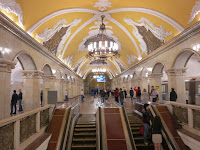
The Glitz of the Moscow Metro

 Millions of people will use this metro system every day and mixed up in the hustle of daily life are these images of significant episodes of Russian history adorning the walls and ceilings of the underground.

Even the Kremlin and Red Square exposed in international media as grey places of military muscle are far from that. The colour again of the buildings both around Red Square and inside the Kremlin [which means fortress] walls make the whole environment alive and fun. Lenin must be rolling over in his Red Square tomb as it looks out onto the commercial centre of consumerism in the 'Gum' shopping centre immediately across from where the tomb is located.
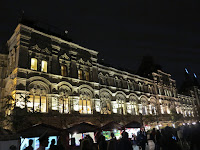
Gum Shopping Precinct
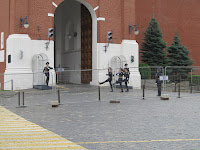
On Guard in Red Square
            
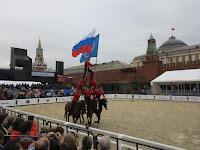
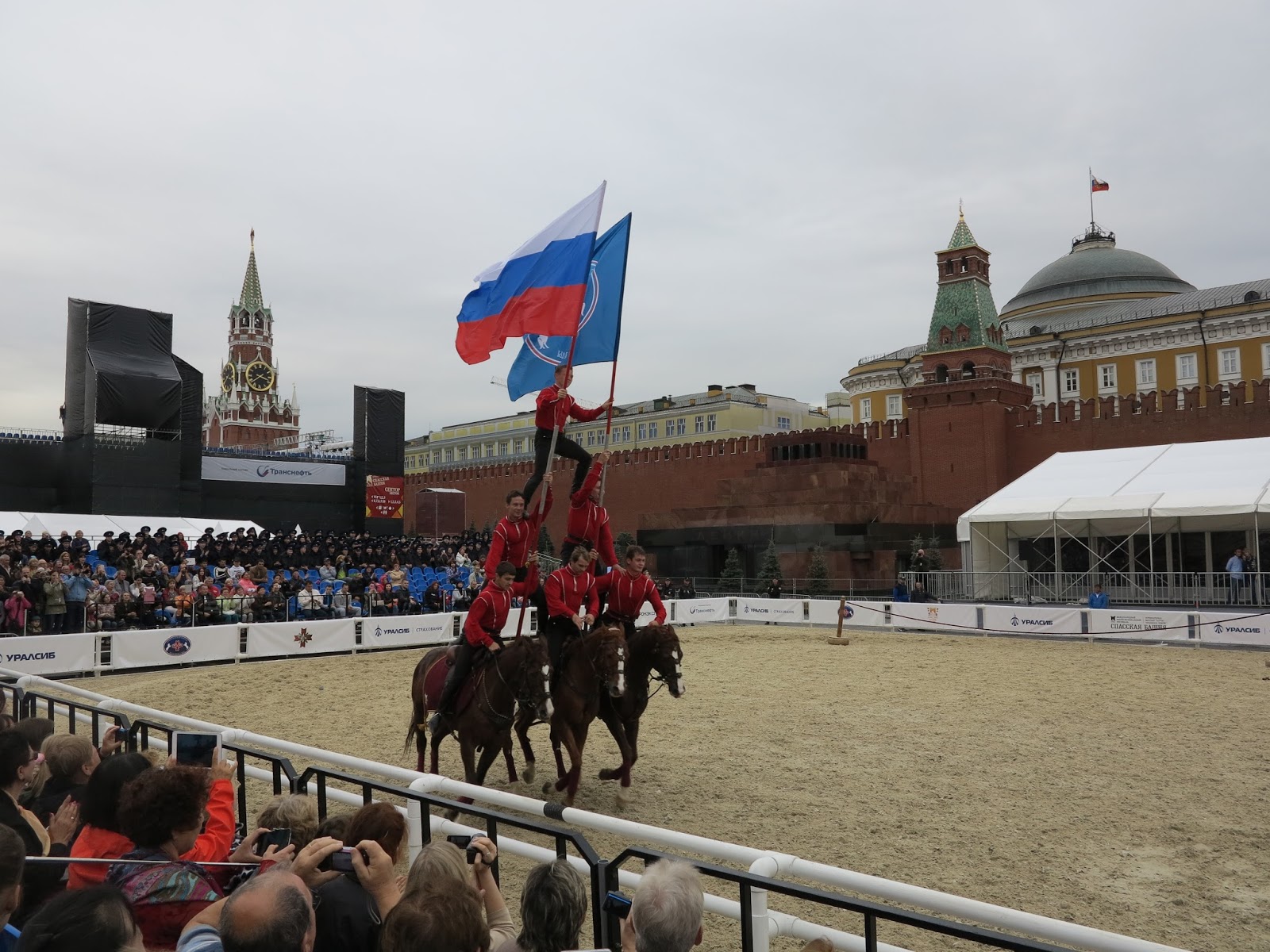
There is some sentiment here that sooner or later his tomb will be moved maybe to where the other former President are entombed elsewhere in Moscow city. Apparently there is always scaffolding up in Red Square as it hosts party celebrations for Moscow's 837th birthday this weekend coming and at other times cultural events and concerts. Concerts are popular because they are big revenue gatherers for the Government.
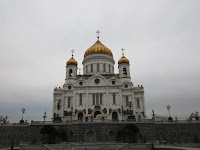
Christ the Saviour Church
Preparation, Red Square for 837 birthday celebrations
                                 

The Church of Christ the Saviour is one of the most impressive structures we have seen. A Russian orthodox church it was made famous recently by Pussy Riot - the girl punk band that was arrested for performing anti-Putin songs on the doorstep.

All around the city are the Stalin [wedding] cakes - buildings initiated by Stalin and now the homes of Hotels [eg Radisson] and apartment blocks. They leave a defining image on the Moscow skyline. But like any huge city [of in excess of 12,000,000 people] traffic becomes a huge problem;

    
Radisson - Stalin's Wedding cake - by day and night

congestion in the Russian rush hour is like any western city; but perhaps scariest of all are the three laned open roads with a common middle lane used by vehicles to overtake in both directions; drivers really need to be on the alert but in allour travels here we have seen only one small nose-tail collision [other signs on the sides of the highways suggest more frequent serious results!].


Inside and outside the Kremlin

The road to Zagorsk and the Russian Orthodox Church of  St Sergius proved to be a real highlight; the experience of ongoing service at the re-burial place of the former founding monk of the Monastery and the art that adorned the walls was simply awesome.


Buildings and Guard - both at attention

Moscow is certainly a place to come back to. It is clearly different from Mother Russia, the rural embodiment of the down-to-earth Russian ethic; and as commercial centre and capital it is different from the slower pace of Saint Petersburg; it is in essence, a country within a country.

    
Rural Russia - Dacha's in the Heartland outside of Moscow